It never fails to intrigue me how amid struggle & uncertainty, the human mind adapts. Our world is facing numerous challenges and to be fair, has always faced numerous challenges. Nevertheless, given the immediacy of media at our fingertips and our ever-more connected global landscape, secondary trauma is hard to avoid and overlaps on top of personal traumas. For many of us, our nervous systems are primed and on guard—ready for when the so-called “other shoe drops”.
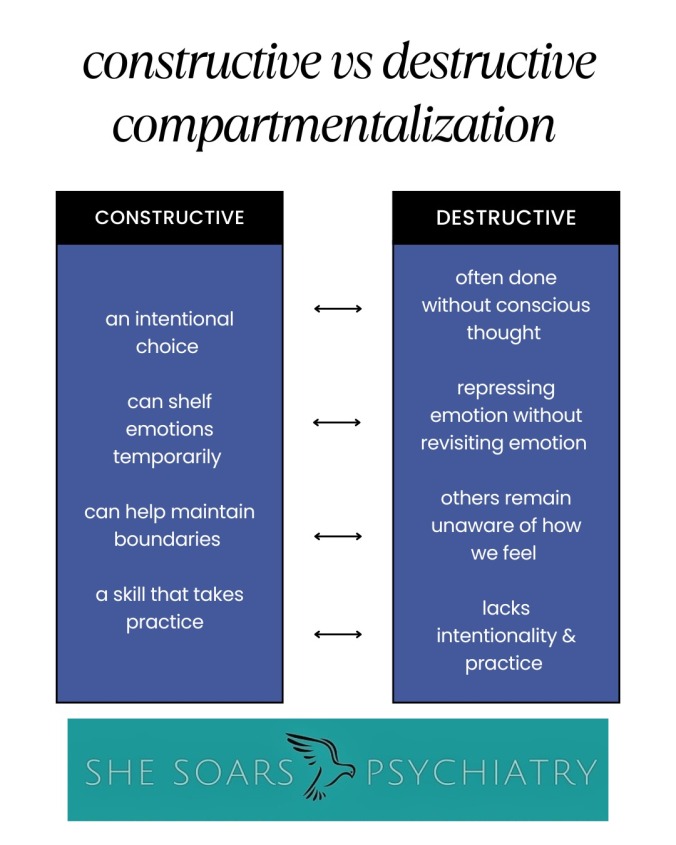
Compartmentalizing emotion is one of the primary means humans cope and maintain functionality when facing trepidation and uncertainty. It is evolutionary to minimize the gravity of emotion when the priority is survival. Emotional processing can be counterproductive and near impossible in the absence of safety. And yet, unchecked, compartmentalization can also lead to detachment, cognitive dissonance, and apathy…all things plaguing our world today.
In my day job, it is a practice listening to stories of trauma and loss, maintaining an empathetic presence, and also a therapeutic shield. Generally, this has a way of working, but there are those days when the balance of compartmentalization seems too much or too little. Days when emotions feel too heavy and days when emotions feel too distant.
Compartmentalization is a spectrum. While often essential to survival, compartmentalization can also help facilitate productivity, focus regulation, & selflessness. My concern is on the edges of this spectrum when compartmentalization is too much or too little. How do we find better balance in staying emotionally connected but not emotionally saturated, empathetic without becoming overwhelmed, engaged without becoming consumed?
Find Opportunities to Emote
Many of us easily provide space for others to emote while we limit our own emotional expression. If these limitations are too rigid, we can become a bit emotionally constipated. As follows, we need to acknowledge emotion, digest it, metabolize its messaging, and let it pass. When we disregard our own emotion it becomes far easier to disregard emotion in others. Stoicism can become cold or bitter. Emotions are not always convenient, but they are messages that can facilitate important action. Find ways to acknowledge & release. Put it on the schedule. For me, emotional catharsis is best found on the back of my horse under the mountains, with music, and running through woods.
Connecting to meaning
It is not my place to tell anybody what is meaningful, but it is important that I tell them that the search for meaning is worth it if not imperative to emotional resilience. Finding meaning allows us to better integrate suffering as something that can coexist with peace. This ability to straddle paradox, buffers against denial and detachment. Suffering, as awful as it can be, can also be a catalyst to finding meaning and deepening connection. It is also completely expected that many of us will have our share of existential moments when meaning feels elusive and when we question the point of it all, but these moments can also be opportunities to more carefully evaluate personal values and beliefs.
Shake it up a bit
When we operate in compartmentalization mode for too long, life can start to feel a bit robotic. Routines, perceived control, and predictability feel paramount while spontaneity and lightness take a backseat. It is important that we give ourselves opportunities to be awed and to intermittently shake ourselves out of detachment. I prefer to go to wild places where comfort is not guaranteed and where my senses must be enlivened. Also, spending time with my niece and nephews in their toddlerhood seems to do the trick.
Find Your Battlefield
Find something worth fighting for. Yes, some fights might ask for a fist or a trigger, but some of the best fights are not out of violence or vengeance, but the stubborn insistence to shepherd the values of dignity and respect for ourselves, our neighbors, our community, our country, & our planet. Fight with acts of kindness, fight with facts, fight with humility, fight with service, fight with advocacy, and fight with wellness that preserves our stamina. A good fight is a good antidote against detachment.
We all deserve intermittent breaks of emotional respite. Those breaks are also too often a privilege. We can mindfully compartmentalize without mindless detachment. We can strategically postpone emotion and also intentionally acknowledge emotion. We can restrain and we can act. Cheers to staying engaged, resting well, & staying connected.
Thank you for listening.
With gratitude,

Audry Van Houweling, Owner,
Sisters & Silverton, Oregon
 She Soars psychiatry, LLC