The Costs of Exclusion

A few weeks ago, along with millions of other Americans, I sat on a blanket, ate my pie, and watched the fireworks light up the sky. Patriotism is a loaded term- what it means is particular to the individual. For some it is a sentiment that comes with great pride, for others ambivalence, and for others skepticism and shame. We have all had our own unique American story- some of us have been prosperous and graced with opportunity while others have a story of struggle.

My mind went all sorts of places during the fifteen minutes of bright booms above me. As I surveyed the near-idyllic small town gathering surrounding me gasping and cheering, I felt a deep sense of privilege that somehow life afforded me to be in that moment cozied up to people I care about, safe as can be, without worry. I ruminated on the ‘unalienable’ rights- life, liberty, and the pursuit of happiness. A powerful standard still not guaranteed for some. I thought of my own roots, my generational story, and the hardship and resilience that made possible my own citizenship and opportunity. And in the flashes of illumination above came the images of children caged on the border – some only infants- sleeping on concrete floors, often without parental care, many without minimal physical comfort, and amidst my gratitude and patriotism was a mix of shame, anger, and sadness.

girls on concrete

Two young girls sleeping on concrete at a Texas detention center.

Movement and nomadism are a part of human nature. Whether we are moving across town or across borders, the reasons we do so are varied, but most often involve seeking a greater sense of stability, acceptance, importance, or security. If we are lucky, we may move for simply aesthetic reasons wanting more space, more modernity, more grandeur. Yet much of humanity moves out of necessity- perhaps for financial reasons or eviction, but also for safety and survival.

My maternal grandmother was born in Warsaw, Poland. Her father was a physician and professor at the local university while her mother stayed at home. She was raised Roman Catholic, was afforded a top-notch education, enjoyed the arts, and traveled often.

On September 1st, 1939, the Nazis invaded Poland. My grandmother was 15. While not Jewish, her father was targeted as being part of the intelligentsia and so, my grandmother was relegated to the Warsaw ghetto, then separated from her parents who were never seen again. Then, given her vitality, she was chosen for forced labor rather than execution. While details remain a bit of a mystery, my grandmother escaped the forced labor camp, but while working for the underground in France where, she was captured again by the Germans and imprisoned in Frankfurt for two years until the end of the war when she was finally liberated. There was not much left for her at home in Poland and so, my grandmother who spoke no English (despite speaking at least four other languages) made the journey to Ellis Island along with so many others seeking something better and the promise of Lady Liberty.

Jewish kids

Jewish refugee children catching sight of Lady Liberty.

Somehow out of such horror, my grandmother managed to make a life for herself in the United States. She married, had two children, settled in Long Island in comfortable suburbia, and later retired to a gated community in Palm Beach, Florida. Despite her unwavering resilience, it was not always pretty. The stain of the Holocaust brought nightmares and flashbacks, memories that compelled a quest to numb or distract with alcohol, pills, and risky behavior. Her traumas became also her children’s traumas and while her reasons for absenteeism or emotional distance as a parent are understandable, they were not without consequence. This is one version of inter-generational trauma.

Last week I enjoyed a brief visit to New York. As I toured the Auschwitz exhibition at Manhattan’s Museum of Jewish Heritage, I was struck most by a photo of a German family with young children- they are laughing and enjoying a swim in their backyard only 400 feet from the crematorium that in sharp contrast was burning thousands of murdered bodies each day. How is this possible?

Desperation loves a scapegoat. After World War I, Germany was hurting- and hurting bad. The financial situation left over a third of the country unemployed and grasping for hope or purpose. Hitler’s vision not only offered a way forward, but an enemy that was much more tangible and familiar than the complexities of the country’s crisis.

“The art of all truly great national leaders at all times consists in not dividing the attention of a people, but in concentrating it upon a single foe.” -Adolf Hitler (1925)

One way to a sense of pride is through unification and another, through division. Hitler did both. He unified the ‘Aryan race’ and by convincing those lucky enough to fit this description that they were superior, he enhanced their perceived pride even more by justifying the ostracism and persecution of millions. Germany quickly became Europe’s superpower, dominating economically and militarily. German author Raimund Pretzel (1928), describes the intoxicating Nazi vision among the German people:

“They are terribly happy, but terribly demeaned; so self-satisfied, but so boundlessly loathsome; so proud and yet so despicable and inhuman. They think they are scaling high mountains, when in reality they are crawling through a swamp.”

Germans

German gathering outside of Auschwitz

It is unsettling what we can become accustomed to- what we quietly accept especially when we ourselves are hurting. It can start small- perhaps with a suggestion or slur at the family table, then rhetoric spreads to groups, then to public acceptance of discrimination and segregation, then to widespread banishment and dehumanization, then somehow to mass genocide.
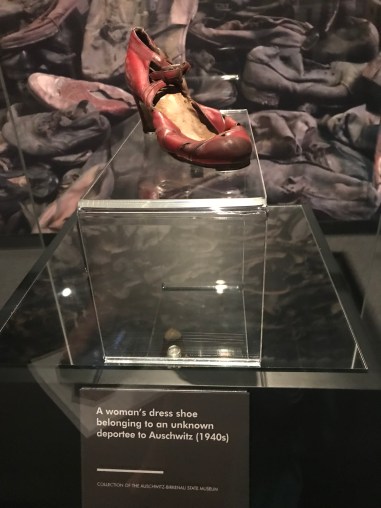
IMG_2285

A single red shoe belonging to one of the millions murdered at Auschwitz.

IMG_2301

Children’s clothing and objects found at Auschwitz.

It is well known that being excluded has deep emotional consequences, but what do we lose when we ourselves are the aggressor of exclusion? We often do so to seek a sense of solidarity or significance with other aggressors. We want to belong- just as every human does. Yet, the method by which we are seeking belonging involves hate, denial, dehumanizing, and anger. This demands a significant amount of energy, and detachment. And, quite frankly, anger is toxic on the mind and the body. The pain we inflict on others becomes our path to prosperity and reconciling this means we must create a worldview in which causing hurt is necessary. Ultimately, we create a very rigid and small world that must be maintained in order for us to have any sense of satisfaction. Problem is, this rarely happens, and we are often confronted, albeit maybe only on our deathbeds, with our legacy.

I write this not to make a political statement, but to remind myself and perhaps anybody who reads this that the seeds of hate are often apathy and desperation. It takes courage to acknowledge responsibility and look within rather than seeking to blame another. Furthermore, I am reminded of weight of our words. As I left the museum, I was challenged most by the following statement from Auschwitz survivor, Simone Alizon:

“Our words are not your words. Ramp does not equal platform. Number does not equal name. Segregation or selection does not equal choice. Barracks does not equal building. And today words have the power. And it is also destructive. On the internet, in discussion, on forums, in comments. In the media, titles, captions. In the groups of notions where the people who are poor, cringing, running away…are presented as people with germs and diseases. In the language of political debate, to demagogy, in populism. In brutal opinions of those who, supposed to serve, want to lead. The words of hatred poison the imagination and stupefy consciousness. Maybe this is why so many remain silent while confronted with evil. The words of hatred create hatred. The words of dehumanization dehumanize. The words of menace increase the threat. We have already started paying for this. The camp is not just a memory. For the majority of us, its reality is omnipresent in our everyday life. I have never heard a more terrible warning. The warning against our own words.”

Thanks for listening everyone.

blog-me3


Audry Van Houweling, Owner She Soars Psychiatry,

Sisters & Silverton, Oregon

www.shesoarspsych.com

From a Woman in Between: Contemplations on Abortion

In my job it is an undeniable fact that legislation and policies directly impact the emotional well-being of my clients and admittedly, myself. Amid our national division and contention, many of my clients have reported feeling powerless, disheartened, silenced, and unnerved.

With suicide rates, depression, and reported levels of stress on the rise, it is short-sighted to blame rising mental illness only on individual pathology rather than acknowledge the societal systems and policies reinforcing our national unrest.

In my work, the majority of my clients are women and girls. My youngest client is 5 years old while my eldest are in their eighties. I have the privilege of hearing stories across generations, backgrounds, faiths, and political beliefs. While each client is unique, the themes of powerlessness, trauma, and self-doubt resurface again and again.

powerless1

I would consider myself to be a ‘woman in between’. Perhaps I can blame this on being a classic, peacemaking middle child where a slight bit of resentment lies, but wherein also lies the need to methodically evaluate both sides, appreciate nuances, and an unrelenting curiosity to know somebody’s story.

I resent labeling and believe labels can often be limiting. I think I might subscribe to the “common sense and decency” political party if I ever thought that could exist in politics. I prioritize my faith and spirituality, but have difficulty committing to any specific set of beliefs. I enjoy brief urban excursions where I pretend to be a version of hipster and fancy, but I feel most at home in the solitude of sagebrush and mountains. I worry daily about the wrong people having access to firearms but relish the chance to be hunting in the wilderness with my rifle on my back. My playlist is varied: from hip-hop to alternative to country. I am a ‘woman in between’ and when it comes to abortion, my opinions are scattered on both sides of the fence. I don’t like it…I think it is sad, but I also think that women and girls far too often find themselves in places of desperation, powerlessness, and self-preservation that unfortunately make the tasks of carrying a child and motherhood daunting, if not seemingly impossible. And so, for too many women and girls, deciding whether to follow through with pregnancy or not comes down to survival on a physical, psychological, and spiritual level.

Women and girls have for far too long been well acquainted with the feeling of powerlessness. This past week alone I think I sat with five clients of all ages who for the first time disclosed being sexually assaulted. Additionally, women frequently describe feeling taken advantage of in other ways- at their workplace, in the home, and the many times that others have tried to capitalize on their gifts of hospitality and empathy. As a provider, you develop unique ways to empathize while also guarding yourself from the emotional intensity. Every so often, the heaviness hits and I find myself escaping to the woods, blasting my music on random back road drives, or exhaling my frustration to be beat of my horse’s hooves.

What unsettles me most is how our autonomy as women continues to be threatened. Women around the world continue to battle for the right to drive, the right to choose their partner, the right to express their sexuality, the right to consent, and the right to financial decision-making. We have been seen as property, as inferior, as hyper-emotional, as objects. While in some parts of the world there have been great gains, in others time seems to be standing still.

Unfortunately, in the United States, having a child can be one of the greatest threats to our autonomy.

For too many women, having a child poses considerable risks. While these risks may be more or less present depending on the woman, they should not be dismissed or ignored while we try to safeguard the lives of the unborn but do little to address the systemic pressures creating these endemic risks in the first place.

Here are the facts:

  1. The United States has the highest maternal mortality rates of any developed country.
  2. While other developed countries have seen a steady decline in maternal mortality, mortality has increased in the United States.
  3. Black women have a maternal mortality rate 3 times higher than white women.
  4. Only 13 percent of mothers have access to paid leave.
  5. While men are known to make an average of 6% more on their paycheck per each child, women are known to lose 4% per each child.
  6. Throughout the country, the annual cost of infant childcare can be equal to if not more expensive than a year of college tuition.
  7. Nearly half of all women who have abortions live below the federal poverty level.
  8. 1 in 3 women will experience sexual violence in her lifetime.
  9. Postpartum and mental health supports are lacking nationwide.
  10. Abortion rates in countries with the most restrictions are higher (37 per 1000) versus countries with the least restrictions (34 per 100).

Perhaps the questions we should be asking are: How can we come together to minimize these risks? How can we make motherhood less daunting? How can we honor the unborn, but also prioritize the health and wellness of future mothers? Are we holding men and boys as accountable to the fate of our unborn as we are women and girls? It seems that men can abort their responsibility as fathers without legal consequence- is this fair? How are we addressing sexual violence? What about poverty, parental leave, mental health supports, and affordable childcare?

Ultimately, the abortion debate has simply been another opportunity for division, sweeping generalizations, and ‘otherizing’. The concept of addressing root causes that so significantly impact the health of mothers, children, and families might, despite the contention, hopefully bring unity.

“For every effect there is a root cause. Find and address the root cause rather than trying to fix the effect, as there is no end to the latter.” -Celestine Chua

Thanks for listening everyone.

With gratitude,

kiger gorge

Audry Van Houweling, Owner, She Soars Psychiatry, LLC

Sisters & Silverton, Oregon

www.shesoarspsych.com

Binging, Booze, Boys, Bags, & Beachbody… Our attempts to escape the inescapable.

Do you struggle with sitting still? Is watching a movie, reading a book, or even having a conversation a test of your patience? Many of us have become accustomed to a routine of constant stimulation and distraction. Embracing the present can seem counterproductive, like a waste of time, or perhaps even painful. As women we can be pros at creating distractions for ourselves or about reaching an outcome. We give ourselves kudos for being master jugglers. We are praised for our maternalism and caring capabilities, and yet self-care can be met with skepticism.

Afraid of confronting destructive beliefs and patterns, we externalize our problems and blame our bodies, relationships, work environment, and finances among other “causes” rather than looking within. And so, we rely on such things as binging, booze, boys, bags, and never-ending body projects to keep us occupied and detached from our truth. We lose patience as patience is nothing more than simply accepting the present moment.

A note on binging…

blog-binging

It is often a cycle of guilt, shame, and secrecy. Perhaps when the kids are in bed and the husband is not watching, or a hush-hush trip through the drive-thru, or a secret “snack” drawer at work. Everyone is allowed a sugar-spree every so often, but when binging and food becomes a false sense of control or the mechanism by which we quell our emotions, it can become dangerous and destructive. Rather than feel the discomfort, fear, sadness, or grief, we drown it out with the fleeting pleasure of sugar and salt on our taste buds. We might gain weight, or we might purge to try to cover up the “evidence”. The guilt takes over and then the feelings, which must again be quieted.

A note on booze…

BLOG-BOOZE

While there has been a recent spotlight on opioid and prescription drug use, alcohol use has quietly been climbing and deaths attributed to alcohol continue to rival any other substance. High risk drinking, which was defined in the study as women consuming more than 4 drinks per day or men consuming more than 5 drinks per day increased by 30% between 2001-2002 to 2012-2013. Among women specifically, high risk drinking increased by nearly 60%. In the Northwest, alcohol consumption and being privy to the latest and greatest brew pub is associated with social prowess and prestige.

A note on boys…

blog-boys

Lust, codependency, and compromising our own comfort to satisfy. It is human nature to fantasize and want to please to an extent, but boys or whomever you place affection can be a powerful distraction and our means to validation and self-worth. We might be plagued by self-doubt if we assume we are not meeting expectations. Sometimes we may subconsciously (or consciously) seek out or relive situations reminiscent of past traumas or heartache to try to make the traumatic pleasurable or find power when we previously may have felt powerless.

 A note on bags…

blog-bags

I was in Las Vegas recently and took some strolls through the opulent designer rows filled with top trends to satiate high rollers. It is all a bit exciting for a moment and then I found myself rather quickly disillusioned. I suddenly felt pride for my $15.00 Target purse and my sleek black jumpsuit I got from Ross Dress for Less. Really, who gives a damn and if they do, do I give a damn? I must admit I enjoy shopping, fashion, and I understand the power of a first impression. That said, character is not defined by designer labels and if you think external possessions are going to make you happy, you will be quickly disappointed. When it comes to judging one another based on materialism, quite frankly, my give a damn is busted. I think your’s should be too.

A note on Beachbody’s…

blog-food

Your body is your vessel and if you can walk, talk, move without pain, digest your food, and have a healthy heart, there is so much to be grateful for. Many cannot say the same. We take the power of our body for granted as women and we fight the inevitable process of change. We believe that we must punish our body’s until we reach a socially predetermined goal. Through deprivation and often exhaustion we may lose the 10 pounds, but weblog-beachbody reach it having done so with a mentality of shame and self-degradation. We tell ourselves we will finally be happy when we have a 6-pack, lose 10 pounds, run the race, or get rid of the jiggle. Problem is we are acting out of fear rather than love and when fear is the driver, we almost always crash.

Okay so now what?

Okay so you have some vices, guilty pleasures, or admittedly, self-destructive behaviors. Now what?

  • You must take time to practice being OK with the present, which means learning to acknowledge your feelings and fears. This takes practice and intentionality and it might take professional help. Deep breathing, meditation, keeping a gratitude journal, taking a sensory inventory are all small ways to invite the present. This takes practice and intentionality and it might take professional help.
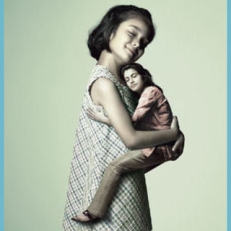
  • Acknowledge your inner child- it is likely desperate to be heard. Picture a hurt child coming to you for help- would you deprive, degrade, and punish that child? That seems cringeworthy as most of us would seek to help that child with gentle curiosity. “What’s wrong? How can I help? Tell me what hurt you? I am here for you. You are going to be OK.” Perhaps then we should be kinder to the wounded child within ourselves. inner child
  • Question everything. Question your core beliefs. Are they born out of fear of love? What behaviors and patterns are energy restorative versus energy depleting? Are you acting and behaving out of compliance or tradition? Has this caused you to sacrifice your personal truth?
  • Treat self-care as a responsibility. This means you honor yourself- your mind, your body, and your spirit. You honor yourself because the energy that you bring into this world has consequences- positive and negative from interacting with the grocery store clerk to your spouse. Take ownership of your energy.

Remember, the present is all you have. Right now, right here, there is power.

Thanks for listening everyone.

blog-me3


With gratitude,

Audry Van Houweling, Owner, She Soars Psychiatry, LLC

www.shesoarspsych.com

Sisters & Silverton, Oregon


Breaking the cycle of negative self-talk

How often do you seek out silence? Solitude? Are you afraid of it? Does it make you uncomfortable to be alone? Silence has become an anomaly in our high speed, digitalized world and we have become accustomed to distractibility that drowns out our own thoughts. Escapism via screen time, substances, spending money, pornography, food, and other means has become commonplace and has made embracing the present moment more and more elusive.

bighorns1

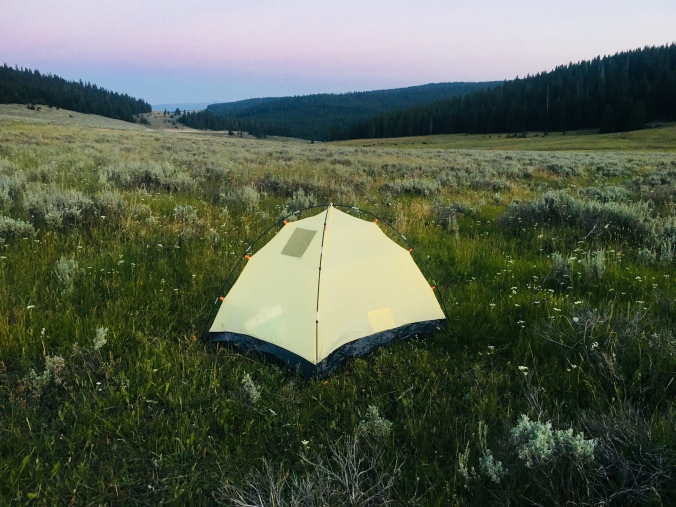
My recent attempt at solitude in the middle of the Bighorn Mountains, Wyoming

Many of us struggle with negative self-talk. Many of us avoid silence, being alone, and continually seek out ways to distract and temporarily pacify our negativity. We become accustomed to “noise”, chaos, and obsession, which are all often a means to avoid confronting deeper roots of discontent. The noise, chaos, and obsessive thinking is named as the problem; however, addressing underlying core beliefs, trauma, and the “inner child” may feel even more problematic and thus the pattern of diversion continues. Many of us have also been told the cowboy lie to pull ourselves up from our bootstraps. Healing is not accomplished by running from our feelings. The medicine for pain is allowing ourselves to feel the pain.

Perfectionistic attitudes, the superman/woman complex, and the belief that the means somehow justify the end can go hand in hand with this unrest. We believe that if we just push ourselves enough, endure an amount of suffering, deprive ourselves for long enough, then perhaps we will meet an end that finally makes us feel “worthy”. This is not to say there is not value in hard work but being attached to an outcome that somehow dictates our self-worth is problematic. Many of us are convinced that we must somehow punish ourselves to feel a sense of accomplishment. Sounds absurd, right? Well yes, it is.

When we reach societal milestones of success, we reach them with the same self-deprecating, punitive mindset that led us there in the first place. Frustrated, we often find another obsession or distraction to latch onto. We find convenient scapegoats…our weight, our job, relationships, as the source of our discontent, yet we are many times afraid to recognize ourselves as the common denominator. And by the way, this takes a lot of insight and humility.

Negative self-talk is learned, rooted often in childhood, and perpetuated through various life experiences, relationships, and socioeconomic circumstances among other factors. Confronting what can be traumatic is difficult and may demand professional help. It necessitates time to process, which means, yes, quiet, stillness, and space to be mindful.

Bighorns2

Cloud Peak Wilderness, Wyoming

Negative self-talk does not simply go away. We are all bombarded with constant comparison, societal expectations, and judgments that can make even the most self-assured insecure. We can however strengthen our “inner observer”- that voice or conscience that questions the value or necessity of a thought or feeling. It is this observer that can acknowledge a feeling- not run from it, not distract it away- but see it for what it is and question the value of identifying with it or not. The inner observer invites curiosity about our feelings as we look to ask why the negativity is there in the first place.

kiger gorge

Kiger Gorge, Steens Mountains

Your inner observer may be akin to faith or the divine. It can become an internal compass allowing us to see toxicities with greater clarity and emboldens us to seek that which grounds us. This may lead to crossroads as you contemplate old patterns that kept you stuck versus new possibilities.

Ultimately, connecting to your inner observer means becoming comfortable with “you” again and questioning the stories we tell ourselves about our feelings. It means recognizing the present moment and embracing the belief that perhaps simply because you are alive, able to breathe the air, and have the capacity to love and be loved might just mean that for right now in this moment life is OK and perhaps even beautiful.

With gratitude,

2017-09-09 Audry VanHouweling Headshots (2 of 2)

Audry Van Houweling, PMHNP-BC, Owner

She Soars Psychiatry, LLC

Sisters & Silverton, Oregon

Compassion Fatigue & Vicarious Trauma

In my job I hear a lot of stories. I hear stories of enormous tragedy and loss, but also stories of great strength and resilience. I have and always will consider it a great privilege to be witness to these stories and the vulnerability intertwined within the ups and downs of life. Like most helpers and healers, I would consider myself an empathetic person capable of appreciating what it might be like in someone else’s shoes.

It seems empathy is in high demand these days. Helping professionals, healers, or simply those with caring personalities may feel overwhelmed and even exhausted trying to meet this demand. Having a caring heart and a tendency to put others ahead of ourselves makes us especially vulnerable to compassion fatigue. ‘Compassion fatigue’ a term coined by Dr Charles Figley, is a “state of tension and preoccupation with the suffering of those being helped to the degree that it can create a secondary traumatic stress for the helper”. Compassion fatigue occurs hand in hand with vicarious trauma, which is when ‘the helper’ is exposed to the traumatic experience of another and experiences a personal transformation resulting in a multitude of possible symptoms including anxiety, panic, sleep changes, depression, hypervigilance, and social isolation among others.

compassion fatigue2

Vicarious trauma and compassion fatigue may lead to feelings of being unsupported and underappreciated. We may also be a tendency to roll up our sleeves and become workaholics- in a search to find control and distractibility when we may feel powerless in other aspects of our lives. We may also find ourselves justifying maladaptive coping mechanisms because of the good and hard work we do. It may be easy to blame our struggles on circumstance and others, but ultimately we need to look within ourselves to find answers and solutions.

Vicarious trauma and compassion fatigue can occur among educators at a loss of how to comfort students fearful of tragedy, or healthcare professionals struggling to provide adequate care to desperate patients, or parents trying to nurture their children in a world that can seem so chaotic, or parents trying to nurture their parents, or leaders of faith trying to restore hope in the hopeless, or first responders repeatedly encountering the aftermath of trauma, or the countless unpaid volunteers and nurturers in our communities working hard to uplift others with often little recognition.

I have learned to be aware of my own vulnerabilities to vicarious trauma and compassion fatigue—and it has not always been easy. I have learned it is critical to have what I call “non-negotiables” or ways of coping that help keep me grounded, present, and emotionally resilient. I have learned it is best not to sacrifice these non-negotiables and if I do, it is not only a disservice to myself, but takes away from my loved ones, clients, and yes, ultimately the communities that I serve. I am not overstating my importance, but have simply grown an appreciation and awareness how my energy and actions reverberate to everyone I come in contact with—and it is the same for you.

compassion fatigue

It is easy to feel hypervigilant about all the woes and fears that may seem so imminent, which makes vigilance about our own well-being so much more important.

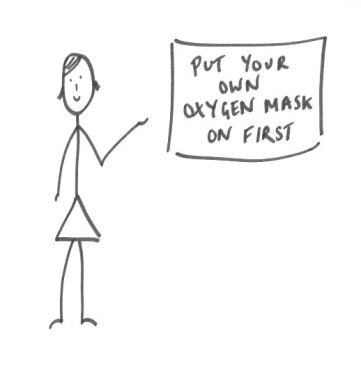
Many of us believe that prioritizing our own well-being aligns with selfishness. In my humble opinion, self-care is a matter of self-responsibility and has nothing to do with being selfish. Importantly, self-care and self-responsibility may also mean asking for help when we feel at a loss. We can only give what we have. It is ultimately not sustainable to be so focused on giving and not restoring. So, in the midst of widespread fear, taking inventory of what we need to keep ourselves grounded and creating dialogue is a necessity.

It is easy to feel lost, on edge, and powerless. Our reality is our perception and perception can change. So let’s help ourselves and one another see the light in the darkness. Take care everyone.

With gratitude,

Audry Van Houweling, PMHNP-BC, Owner She Soars Psychiatry, LLC.

Sisters & Silverton, Oregon2017-09-09 Audry VanHouweling Headshots (2 of 2)

www.shesoarspsych.com

Ladies, we are all traumatized…

Here’s to my first blog post ever! After pondering what I wanted to say, I felt compelled to write about something we all share…trauma. Uplifting? Not so much, but trauma and stress is often the launching pad from which so many chronic conditions arise and it seems fitting that we start with foundations.

That’s right ladies (and yes, men too)- I have a theory that we are all traumatized. If you you have somehow escaped trauma, congratulations, and please share your secrets. Before you call me Debbie Downer and switch to your favorite cooking blog, keep reading- it’s important.

Within conventional psychiatry and psychology, when the burden of trauma elicits a certain set of criteria from a person, they may be diagnosed with post-traumatic stress disorder (PTSD). I personally have a bit of a beef with labels we use in mental health and do not like the word “disorder”. I find it limiting and disempowering.

As I will explain a bit in this post and more extensively in the future, the symptoms that define PTSD may be counterproductive in certain situations, but are rooted in our evolution and survival instincts.

What is trauma? In my assessment, trauma can be characterized as anytime we have a perceived sense of helplessness or loss of control. It is something that has caused harm or has the perceived potential to cause harm. It can be a physical form- a person, a place, an object, or it can be a collection of thoughts, memories, nightmares. Trauma is not necessarily what happened to us, but the effect it has upon us.

Let’s consider some examples. Have you ever been in a car accident? Did you know motor vehicle accidents are the number one cause of “PTSD”? I bet you can remember certain details…perhaps it happened at a particular intersection or stretch of road, perhaps you had a certain song on the radio at the time, or you can remember the time of day, or the weather.

Have you ever felt belittled, harassed, talked down to, discriminated against? Most of us- especially women and girls have had this experience at one time or another. Maybe it was a coworker, a significant other, a stranger on the street, or a family member. Or maybe you are a survivor of sexual assault or abuse…or maybe you witnessed somebody else’s trauma… or maybe you heard about something scary on the news…you see, given all the possibilities, it is hard to imagine anyone would not be traumatized.

Do you notice the discomfort and vulnerability when walking alone? Maybe you carry pepper spray, a knife, or even a gun. Perhaps you have become really good at assessing the scene, looking over your shoulder, looking for signs of danger. Do you find yourself feeling inferior or intimidated around others (particularly men) even when you stand for equality and you know this should not be? Is it hard to look people in the eye, speak up for yourself, be assertive? You may not have actually experienced an attack or harassment, but by simply being privy to stories in the media or from someone you know, you may adopt certain behaviors in response to a potentially traumatic situation.

And then there’s the trauma of not feeling good enough and the negative self-talk that comes with it. For so many of us, we have a constant buzz within ourselves to look a certain way, meet societal expectations, lose the weight, perform in our jobs, buy the right clothes, appease our families, religious organizations, significant others, children… and all the while do it with a smile, because you know, we have to have those Facebook posts just right.

Our society breeds dissatisfaction and it seems that  us women & girls are particularly susceptible to this near-constant, hypervigilant mindset of what must I do to be better? What must I do to be on par with everyone else? Well, maybe I should get some pointers from Facebook, Instagram, etc…see how I measure up…but wait, that did not make me feel any better! This hypervigilance can be traumatic in itself as it creates the ongoing need to feel more and more in control of our appearance, reputation, and what we portray to the world. Unfortunately, this race has no finish line and we often exhaust ourselves trying to find it.

Trust me, I am entirely guilty of this- hard not to be, right? Type A personality, perfectionist, ambitious, afraid to settle…yup, all worthy descriptions of who I am. I do not have a pedestal and even if I did, I would still have my self-doubts…

Trauma is like throwing a stone into the water. There is the initial impact, but then there are the ripples…

Let’s go back to a time when you felt belittled or talked down to. If this has happened a lot in your life, you might find yourself often defensive and feel as though you have something to prove. Can you remember the person that did this to you? I imagine you remember them well. Can you remember where you were when it took place?

Can you remember the feelings of fear, anger, shame…? Have you met others that reminded you of that person, that place, or maybe you have gone further to generalize your experience to being associated with an entire group of people. Ripples…trauma builds on itself. The original trigger multiplies into more triggers and then more triggers from secondary triggers and so on.

Trauma is not something that hides out in the brain. It elicits reactions throughout every system in your body from your head to your toes. Every thought and emotion positive or negative has an associated chemical reaction that is communicated throughout our body. We will go more into this later.

Ever feel achy, sick, fatigued, nauseated in the midst of stress? Yup, a few of the not so uncommon reactions.

Going back to evolution- when we are faced with something potentially harmful or life-threatening, our natural reaction is to fight or flight. Basic survival instincts.

While this can be really helpful when you are being chased by a bear, some of us (actually a lot of us) find ourselves in a perpetual state of fight or flight driven by actual or imagined fears, threats, or circumstances. It is important to remember that events or situations that may not be perceived as “traumatic” can cause this same reaction. Having a baby, starting a new job, moving, starting a relationship are a few examples. We might feel buzzed at first- energized, enthused, but then the surge of adrenaline and other stress hormones may not sustain themselves and we feel the burden of fatigue, burn out, apathy, sadness, and even despair.

Some of us in the midst of feeling the lull, may seek out even more exciting or risky ventures that may spike our interests and adrenaline levels for a while longer before we again fall back and the cycle continues. Addictions work this way too.

You see, some of us can become so familiarized with trauma and chaos that it becomes part of our identity…our modus operandi, our comfort zone, our ego. Some of us may be conscious of this while some of us have not yet recognized it. Do you take pride in being able to juggle so many balls at once? Do you have a silent pride in being there for somebody who may be abusive, but you feel you are the only one that can help? Do you find yourself attracted to gossip and drama? Perhaps you like the thrill of a challenge and have difficulty with stillness, quiet, and slowness? Do you like danger, risk-taking, pushing the envelope? Is it harder to receive love and care then to extend it to others? If you are like a lot of us, the answer is yes, yes, and yes.

How do you identify or label yourself? Might it be that how we define ourselves and the labels we assign to who we are can also cause pain and perhaps perpetuate trauma? If we are too rigid with our expectations for ourselves and keep ourselves in a box, we are likely to be disappointed.

If we are all traumatized, we are also all on a spectrum. Some of us are in the midst of trauma right now. Some of us are struggling to overcome memories of trauma. Some of us are being overwhelmed with the news of our world today.

Ask yourself how you perceive yourself in the midst of the trauma past or present? What is your role? Victim, survivor, witness, standing on the sidelines? How do you also label the person, place, event, or thought process that perpetuated the trauma?

Language is powerful. Remember that feelings are real, but they are not always true.

Medication, supplements, fitness, and lab testing all certainly have their merits in supporting wellness, but true vitality and contentment often lies in how we perceive ourselves and others around us. It is the process of learning to trust ourselves and in doing so, be able to extend trust to others.

Be careful how you perceive yourself, how you label yourself. Be careful not to let yourself be defined with too much rigidity. Embrace fluidity. Be kind to yourself and give yourself grace. Recognize that you are not alone.

I am fascinated with the concept of resilience in the midst of trauma…I would love to hear from you how you main resilient? What keeps you grounded? Please share!

In future posts we will be discussing the physiological impacts trauma has throughout our bodies and steps we can take to restore vitality and stay grounded in the midst of our complex world! So stay tuned!

As always find out more about us at http://www.shesoarspsych.com

Be well,

Audry Van Houweling, PMHNP-BC