The Gap Between Being & Becoming

What are you hoping to become? Smarter, richer, wiser, healthier, more attractive? Mainstream society thrives on selling urgency—the urgency to be better, more appealing, more acceptable. This pressure can manifest as restlessness, workaholism, perfectionism, and an unforgiving inner critic. 

Today, social platforms reinforce this cycle, embedding the expectation that we should continually “uplevel.” The finish line for success always moves further, leaving us chasing perceptions of success. Modern-day acceptance often comes in the form of curated posts and filtered stories, where followers become currency. Life can start to feel like a performance. The pressure to maintain likability and stand out breeds desperation that generally erodes gratitude, presence, and stillness. Too often, we postpone happiness until we “become.” The larger the perceived gap between being and becoming, the greater our unhappiness tends to be. 

The Balancing Act 

Does this mean we shouldn’t have goals? Of course not. Striving gives us purpose and resilience. But should our worth and happiness depend on outcomes? Probably not. While we may seek improved versions of ourselves or our circumstances, it is gratitude for the present that fuels energy for the future. 

Who Are You Becoming For? 

When caught in the race for accomplishments, we need to ask: are we pursuing goals from an authentic place aligned with our values, or from external expectations? Are we driven by fear of disappointment or by courage and strength? Do our ambitions reflect unhealed longings for approval and validation? Is our relentlessness, which can appear outwardly successful, truly a trauma response? 

An Era of Decision Fatigue 

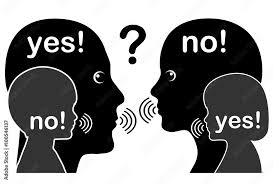
Part of the angst of becoming is that there are so many options of what to become especially partnered with the rampant comparison culture and existential unease. Decicion-making can feel paralyzing. As I work with many young adults, questions loom large: Should I go to college? Move out? Work? Travel? Have kids? With so many possibilities, the weight of “choosing right” can overwhelm. When faced with indecision, our tendency is to stay put in the familiar, sometimes at the expense of growth or healthy risks. At a therapeutic level, the work is less about making the “right” decision and more about building confidence in making a decision. 

Most of Life Is Ordinary 

In our dopamine-driven society, we’re fed the illusion that life should always be stimulating, inspiring, and easy to advance. In reality, much of life unfolds in ordinary routines—the anchors of daily functioning. Days may feel bland, repetitive, even grueling. Accomplishment is often felt in moments sandwiched between the grind of maintaining foundations and committing to a process that can take years if not decades and a whole lot of patience. Profound change is often made possible by repeated small moments of routine and discipline. The key is to enjoy the “in the meantime,” to embrace the process, and to realize that we are “becoming” in the ordinary rhythms of life just as much as the exclamation points of life. 

Nothing Is Permanent 

Finally, remember that what you hope to become today may shift tomorrow. Change is the law of nature. Each day we wake up a slightly different animal. Our vision of who we want to become evolves with time. What we seek to become will change over the course of time and as we are in the interim waiting for our efforts to take shape, the impermanence of life reminds us that as we are being, we are also always becoming.  

Cheers to your journey. 

With gratitude,

Audry Van Houweling, Owner, She Soars Psychiatry, LLC

Sisters & Silverton, Oregon
http://www.shesoarspsych.com

The Art of Compartmentalizing

It never fails to intrigue me how amid struggle & uncertainty, the human mind adapts. Our world is facing numerous challenges and to be fair, has always faced numerous challenges. Nevertheless, given the immediacy of media at our fingertips and our ever-more connected global landscape, secondary trauma is hard to avoid and overlaps on top of personal traumas. For many of us, our nervous systems are primed and on guard—ready for when the so-called “other shoe drops”.

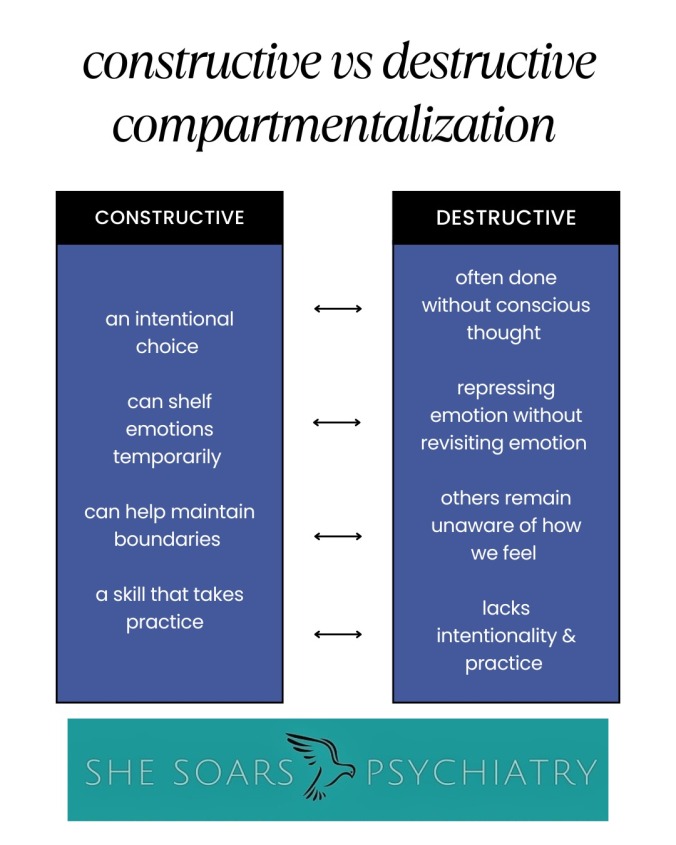
Compartmentalizing emotion is one of the primary means humans cope and maintain functionality when facing trepidation and uncertainty. It is evolutionary to minimize the gravity of emotion when the priority is survival. Emotional processing can be counterproductive and near impossible in the absence of safety. And yet, unchecked, compartmentalization can also lead to detachment, cognitive dissonance, and apathy…all things plaguing our world today.

In my day job, it is a practice listening to stories of trauma and loss, maintaining an empathetic presence, and also a therapeutic shield. Generally, this has a way of working, but there are those days when the balance of compartmentalization seems too much or too little. Days when emotions feel too heavy and days when emotions feel too distant.

Compartmentalization is a spectrum. While often essential to survival, compartmentalization can also help facilitate productivity, focus regulation, & selflessness. My concern is on the edges of this spectrum when compartmentalization is too much or too little. How do we find better balance in staying emotionally connected but not emotionally saturated, empathetic without becoming overwhelmed, engaged without becoming consumed?

Find Opportunities to Emote

Many of us easily provide space for others to emote while we limit our own emotional expression. If these limitations are too rigid, we can become a bit emotionally constipated. As follows, we need to acknowledge emotion, digest it, metabolize its messaging, and let it pass. When we disregard our own emotion it becomes far easier to disregard emotion in others. Stoicism can become cold or bitter. Emotions are not always convenient, but they are messages that can facilitate important action. Find ways to acknowledge & release. Put it on the schedule.  For me, emotional catharsis is best found on the back of my horse under the mountains, with music, and running through woods.

Connecting to meaning

It is not my place to tell anybody what is meaningful, but it is important that I tell them that the search for meaning is worth it if not imperative to emotional resilience. Finding meaning allows us to better integrate suffering as something that can coexist with peace. This ability to straddle paradox, buffers against denial and detachment. Suffering, as awful as it can be, can also be a catalyst to finding meaning and deepening connection. It is also completely expected that many of us will have our share of existential moments when meaning feels elusive and when we question the point of it all, but these moments can also be opportunities to more carefully evaluate personal values and beliefs.

Shake it up a bit

When we operate in compartmentalization mode for too long, life can start to feel a bit robotic. Routines, perceived control, and predictability feel paramount while spontaneity and lightness take a backseat. It is important that we give ourselves opportunities to be awed and to intermittently shake ourselves out of detachment. I prefer to go to wild places where comfort is not guaranteed and where my senses must be enlivened. Also, spending time with my niece and nephews in their toddlerhood seems to do the trick.

Find Your Battlefield

Find something worth fighting for. Yes, some fights might ask for a fist or a trigger, but some of the best fights are not out of violence or vengeance, but the stubborn insistence to shepherd the values of dignity and respect for ourselves, our neighbors, our community, our country, & our planet. Fight with acts of kindness, fight with facts, fight with humility, fight with service, fight with advocacy, and fight with wellness that preserves our stamina. A good fight is a good antidote against detachment.

We all deserve intermittent breaks of emotional respite. Those breaks are also too often a privilege. We can mindfully compartmentalize without mindless detachment. We can strategically postpone emotion and also intentionally acknowledge emotion. We can restrain and we can act. Cheers to staying engaged, resting well, & staying connected.

Thank you for listening.

With gratitude,

Audry Van Houweling, Owner,

She Soars Psychiatry, LLC

Sisters & Silverton, Oregon

Making Peace with Our Multitudes

One of my first patients was a pastor. He was esteemed and well-respected—a pillar in the community. I was a newbie in the small town where his roots ran deep. He was a man of conviction and compassion. He spoke with authority. And he was also sometimes hopeless…and desperate. At twenty-six years old, I sat at my desk sporting my newly printed diploma. I was trying my best to hide my imposter syndrome. Still shaky in my confidence, I kept questioning how a man who has guided so many, seek out any sort of guidance from me? He was a master at portraying steadiness and reassurance for his patrons. He held tight to concepts of duty and responsibility. In a small town, he felt there was little room for any misstep or deviation. Despite being surrounded by people who revered him, he shared with me that he often felt alone…and scared. While I stumbled through coping skills and strategies, I learned that my best intervention was to simply hold space for his complexity and provide a brief respite from the rigidity of his self-imposed and societally reinforced standards. 

Over the years in my practice, I have come to have a deep appreciation for the multitudes we all contain. The pastor and so many others in their courage to be vulnerable, unknowingly also gave me permission to better accept my own depth and sometimes messy complexity. Feelings and thoughts that may seem contradictory can all exist simultaneously. Grief and gratitude, courage and fear, joy and pain, hope and despair. The ability to hold multiple realities and straddle paradox might be one of the greatest measures of resilience.  

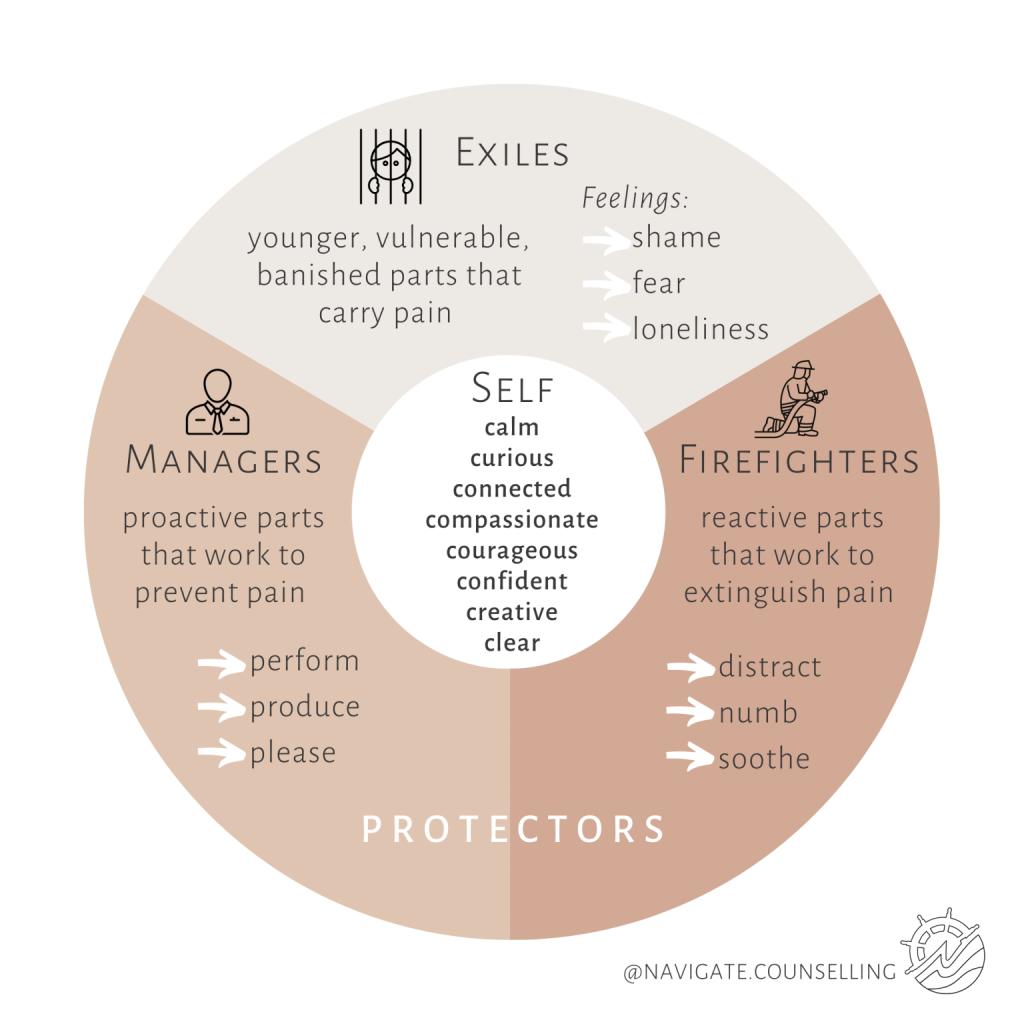
Life can be a bit performative. Like a play, we all take on different roles. The character descriptions will likely differ depending on if we are at work, home, social settings, or alone. This is completely human and to an extent, shows cognitive flexibility and healthy adaptation. Some roles we have mastered. We know the lines front and back. We have become intimately familiar with certain characters. Others, we would prefer to remain out of the spotlight or silenced altogether. The cast of characters can be diverse. Some may be protective, some ambitious, some ashamed, some stubborn, some silly, and some hopeful. At times, we might allow other people or societal expectations to take the director’s seat and choose the cast despite our unspoken resistance. If we have faced trauma or dysfunction, we might favor a cast who seemingly offers protection by seeking control while we might sideline child-like characters who crave lightness and adventure. When faced with a decision, multiple characters may want a seat at the table–at times contradicting one another generating inner conflict. We might have a character begging to take center stage, but fears of judgment or shame keep the muzzle tight. 

Different parts of ourselves as outlined in
Internal Family Systems Therapy

As with most entrepreneurs, I have a strong identification with my professional cast of characters. Defined by productivity, steadiness, responsibility, and a fair amount of rebellion to the mainstream, this industrious cast has a tendency to crowd the stage and can be hesitant to share the spotlight. I call on these characters in times of life’s turbulence and yet, they have been known to create some undue stress themselves. They are supposed to take a bow around 6pm Monday-Friday and enjoy a mini sabbatical through the weekend. Lighthearted characters have had to bargain with them at times, finally convincing them that rest, and playfulness are also necessary ingredients for success. Characters offering grace have also had to remind them that success is, in itself, a construct up for interpretation.  

Sometimes we find ourselves acting in a play we never signed up for. When tragedy strikes, we often default to self-preservation. The protective cast of characters takes center stage. For some of us, this cast of protectors might convince us that the best way to self-preserve is to sideline emotion. We might launch into attempts of control and order, retreat to our work, numb or detach, or dive into martyrdom taking care of everyone else but ourselves. While these characters have likely served important roles in our past, the safety they seek in the present can be a guise for self-sabotage. 

Ultimately, we must remember that none of us are made to be one-dimensional. By remembering that we are by nature, multi-dimensional, we can grant ourselves and those around us more grace. We can remember that everyone has struggles and shadows. We can appreciate nuance and acknowledge complexity. We can know that sometimes those most skilled at portraying a brave face can sometimes be facing the greatest battles. Hold space for your own multitudes and in doing so, hold space for the multitudes of others. 

Thank you for listening.

With gratitude,

Audry Van Houweling, PMHNP-BC

Owner & Founder, She Soars Psychiatry, LLC www.shesoarspsych.com

Sisters & Silverton, Oregon

Cultivate discernment & make better decisions

Buying a piece of custom furniture seems like one of those adult rites of passage. In the latter half of my thirties, I have decided to pursue my first custom piece—a couch. Throughout my nomadic adult years, I have been accustomed to second-hand finds complimenting my frugality and boxed IKEA-ish pieces sure to draw out a few expletives as one navigates assembly and too often, reassembly. I feel ready for the custom, “no-assembly needed”, white glove experience. 

After a prolonged vetting process, I took a deep dive into the very customizable world of “The Pottery Barn”. After scanning images of seemingly endless fabric and color combinations, measuring and remeasuring, thinking far too long about what side the ottoman should be on, I sensed I was hitting the familiar wall of decision fatigue. A bit unenchanted, I order the max number of sample swatches—twelve. I sit on my couch at present that I have a desire to break up with. I think of lounging on the new couch, which leads me to think of lounging on a beach, which leads me to think that as I stare at the sticker shock and then at the two feet of snow outside, I could just take the money and go to Mexico…A classic first-world problem of ineffectual discernment.  

Speaking of discernment, it is an art that is losing steam against a world that bombards us with opinions, choices, and theoretical outcomes. As so many of us are one click away from information overload, the ability to effectively make decisions without so much static and interference is so often an uphill battle. As we might look to avoid the static, some of us prefer the more spontaneous or impulsive way of operating while some of us analytical types might become bulldozed into a state of paralysis by analysis. 

In an era of endless information- too much of which is artificial and false, cultivating discernment seems to be more important than ever before. How? I have five thoughts… 

Integrity to our core values 

If you don’t know your core values, it is a good time for a little self-discovery. Core values are not static, but they serve as an internal compass providing a filter by which decisions must pass through. It’s not easy making decisions from a foundation of shifting sand. Helpful tip to avoid shifting sand? Put down your phone and turn down the noise. Your values offer you a solid piece of ground and a place of clarity amid so many options and opinions. 

Leading with what we know NOW 

It can be hard to predict the future even when we think we have a solid plan. Choosing a couch is one thing, but making decisions about relationships, careers, family, and financial matters can have far more gravity. We can get stuck in the “what if’s” and unknowns. It can help to focus on what is clear at present. While we may dwell on potential outcomes should we change, we may also know that what is happening now is not sustainable.  

Operate from a place of self-trust 

While some decisions may seem crystal clear, many others will feel blurry and rich with complexity. There can be multiple potential paths. Not one path is necessarily right or wrong, but they are simply options all likely with their own peaks and valleys. Trusting ourselves to navigate the outcomes and to take ownership of our responses is perhaps the most important outcome of all. 

Sometimes the hardest thing and the right thing are the same. -Isaac Slade

Your feelings are real, but not always true 

Discernment means acknowledging our feelings while also marrying them with evaluative reasoning and logic as the heart and head come together. If we put too much stock on making decisions based on how we “feel”, it is likely our momentum will only last so long and we may be tempted to engage in counterproductive behaviors. Feelings are important, but not always the best leaders. 

Remember the ripple effect 

Our energy we bring to this world has a ripple effect and the decisions we make will impact ourselves and those around us. These ripples can be both positive and negative all at the same time. The greatest good does not mean everyone goes unharmed. Sometimes the impact of a decision can sting a bit before it feels better. And yet, indecision can sometimes sting more. While being mindful of our impact on others is important, so too is the act of honoring ourselves even if that means ruffling a few feathers. Every decision has consequences, but if our decisions open more room to operate in a place of compassion and integrity, they are worth pursuing. 

“Indecision can often be worse than wrong action.” -Henry Ford

A sincere thank YOU for making the decision to read this today. And should you want to know, in the days since I started this article, my custom, definitely overpriced couch is officially en route. Mexico will have to wait… 

With gratitude,

Audry Van Houweing, Owner & Founder, She Soars Psychiatry, LLC

Sisters & Silverton, Oregon
www.shesoarspsych.com