The Costs of Exclusion

A few weeks ago, along with millions of other Americans, I sat on a blanket, ate my pie, and watched the fireworks light up the sky. Patriotism is a loaded term- what it means is particular to the individual. For some it is a sentiment that comes with great pride, for others ambivalence, and for others skepticism and shame. We have all had our own unique American story- some of us have been prosperous and graced with opportunity while others have a story of struggle.

My mind went all sorts of places during the fifteen minutes of bright booms above me. As I surveyed the near-idyllic small town gathering surrounding me gasping and cheering, I felt a deep sense of privilege that somehow life afforded me to be in that moment cozied up to people I care about, safe as can be, without worry. I ruminated on the ‘unalienable’ rights- life, liberty, and the pursuit of happiness. A powerful standard still not guaranteed for some. I thought of my own roots, my generational story, and the hardship and resilience that made possible my own citizenship and opportunity. And in the flashes of illumination above came the images of children caged on the border – some only infants- sleeping on concrete floors, often without parental care, many without minimal physical comfort, and amidst my gratitude and patriotism was a mix of shame, anger, and sadness.

girls on concrete

Two young girls sleeping on concrete at a Texas detention center.

Movement and nomadism are a part of human nature. Whether we are moving across town or across borders, the reasons we do so are varied, but most often involve seeking a greater sense of stability, acceptance, importance, or security. If we are lucky, we may move for simply aesthetic reasons wanting more space, more modernity, more grandeur. Yet much of humanity moves out of necessity- perhaps for financial reasons or eviction, but also for safety and survival.

My maternal grandmother was born in Warsaw, Poland. Her father was a physician and professor at the local university while her mother stayed at home. She was raised Roman Catholic, was afforded a top-notch education, enjoyed the arts, and traveled often.

On September 1st, 1939, the Nazis invaded Poland. My grandmother was 15. While not Jewish, her father was targeted as being part of the intelligentsia and so, my grandmother was relegated to the Warsaw ghetto, then separated from her parents who were never seen again. Then, given her vitality, she was chosen for forced labor rather than execution. While details remain a bit of a mystery, my grandmother escaped the forced labor camp, but while working for the underground in France where, she was captured again by the Germans and imprisoned in Frankfurt for two years until the end of the war when she was finally liberated. There was not much left for her at home in Poland and so, my grandmother who spoke no English (despite speaking at least four other languages) made the journey to Ellis Island along with so many others seeking something better and the promise of Lady Liberty.

Jewish kids

Jewish refugee children catching sight of Lady Liberty.

Somehow out of such horror, my grandmother managed to make a life for herself in the United States. She married, had two children, settled in Long Island in comfortable suburbia, and later retired to a gated community in Palm Beach, Florida. Despite her unwavering resilience, it was not always pretty. The stain of the Holocaust brought nightmares and flashbacks, memories that compelled a quest to numb or distract with alcohol, pills, and risky behavior. Her traumas became also her children’s traumas and while her reasons for absenteeism or emotional distance as a parent are understandable, they were not without consequence. This is one version of inter-generational trauma.

Last week I enjoyed a brief visit to New York. As I toured the Auschwitz exhibition at Manhattan’s Museum of Jewish Heritage, I was struck most by a photo of a German family with young children- they are laughing and enjoying a swim in their backyard only 400 feet from the crematorium that in sharp contrast was burning thousands of murdered bodies each day. How is this possible?

Desperation loves a scapegoat. After World War I, Germany was hurting- and hurting bad. The financial situation left over a third of the country unemployed and grasping for hope or purpose. Hitler’s vision not only offered a way forward, but an enemy that was much more tangible and familiar than the complexities of the country’s crisis.

“The art of all truly great national leaders at all times consists in not dividing the attention of a people, but in concentrating it upon a single foe.” -Adolf Hitler (1925)

One way to a sense of pride is through unification and another, through division. Hitler did both. He unified the ‘Aryan race’ and by convincing those lucky enough to fit this description that they were superior, he enhanced their perceived pride even more by justifying the ostracism and persecution of millions. Germany quickly became Europe’s superpower, dominating economically and militarily. German author Raimund Pretzel (1928), describes the intoxicating Nazi vision among the German people:

“They are terribly happy, but terribly demeaned; so self-satisfied, but so boundlessly loathsome; so proud and yet so despicable and inhuman. They think they are scaling high mountains, when in reality they are crawling through a swamp.”

Germans

German gathering outside of Auschwitz

It is unsettling what we can become accustomed to- what we quietly accept especially when we ourselves are hurting. It can start small- perhaps with a suggestion or slur at the family table, then rhetoric spreads to groups, then to public acceptance of discrimination and segregation, then to widespread banishment and dehumanization, then somehow to mass genocide.
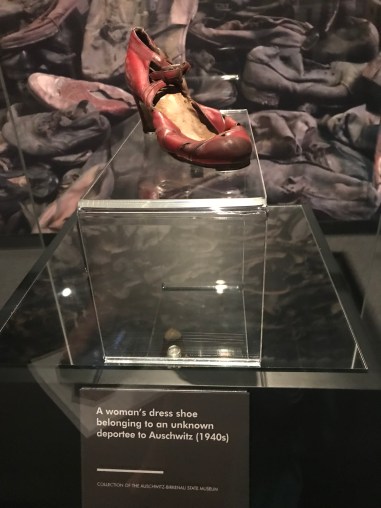
IMG_2285

A single red shoe belonging to one of the millions murdered at Auschwitz.

IMG_2301

Children’s clothing and objects found at Auschwitz.

It is well known that being excluded has deep emotional consequences, but what do we lose when we ourselves are the aggressor of exclusion? We often do so to seek a sense of solidarity or significance with other aggressors. We want to belong- just as every human does. Yet, the method by which we are seeking belonging involves hate, denial, dehumanizing, and anger. This demands a significant amount of energy, and detachment. And, quite frankly, anger is toxic on the mind and the body. The pain we inflict on others becomes our path to prosperity and reconciling this means we must create a worldview in which causing hurt is necessary. Ultimately, we create a very rigid and small world that must be maintained in order for us to have any sense of satisfaction. Problem is, this rarely happens, and we are often confronted, albeit maybe only on our deathbeds, with our legacy.

I write this not to make a political statement, but to remind myself and perhaps anybody who reads this that the seeds of hate are often apathy and desperation. It takes courage to acknowledge responsibility and look within rather than seeking to blame another. Furthermore, I am reminded of weight of our words. As I left the museum, I was challenged most by the following statement from Auschwitz survivor, Simone Alizon:

“Our words are not your words. Ramp does not equal platform. Number does not equal name. Segregation or selection does not equal choice. Barracks does not equal building. And today words have the power. And it is also destructive. On the internet, in discussion, on forums, in comments. In the media, titles, captions. In the groups of notions where the people who are poor, cringing, running away…are presented as people with germs and diseases. In the language of political debate, to demagogy, in populism. In brutal opinions of those who, supposed to serve, want to lead. The words of hatred poison the imagination and stupefy consciousness. Maybe this is why so many remain silent while confronted with evil. The words of hatred create hatred. The words of dehumanization dehumanize. The words of menace increase the threat. We have already started paying for this. The camp is not just a memory. For the majority of us, its reality is omnipresent in our everyday life. I have never heard a more terrible warning. The warning against our own words.”

Thanks for listening everyone.

blog-me3


Audry Van Houweling, Owner She Soars Psychiatry,

Sisters & Silverton, Oregon
www.shesoarspsych.com

From a Woman in Between: Contemplations on Abortion

In my job it is an undeniable fact that legislation and policies directly impact the emotional well-being of my clients and admittedly, myself. Amid our national division and contention, many of my clients have reported feeling powerless, disheartened, silenced, and unnerved.

With suicide rates, depression, and reported levels of stress on the rise, it is short-sighted to blame rising mental illness only on individual pathology rather than acknowledge the societal systems and policies reinforcing our national unrest.

In my work, the majority of my clients are women and girls. My youngest client is 5 years old while my eldest are in their eighties. I have the privilege of hearing stories across generations, backgrounds, faiths, and political beliefs. While each client is unique, the themes of powerlessness, trauma, and self-doubt resurface again and again.

powerless1

I would consider myself to be a ‘woman in between’. Perhaps I can blame this on being a classic, peacemaking middle child where a slight bit of resentment lies, but wherein also lies the need to methodically evaluate both sides, appreciate nuances, and an unrelenting curiosity to know somebody’s story.

I resent labeling and believe labels can often be limiting. I think I might subscribe to the “common sense and decency” political party if I ever thought that could exist in politics. I prioritize my faith and spirituality, but have difficulty committing to any specific set of beliefs. I enjoy brief urban excursions where I pretend to be a version of hipster and fancy, but I feel most at home in the solitude of sagebrush and mountains. I worry daily about the wrong people having access to firearms but relish the chance to be hunting in the wilderness with my rifle on my back. My playlist is varied: from hip-hop to alternative to country. I am a ‘woman in between’ and when it comes to abortion, my opinions are scattered on both sides of the fence. I don’t like it…I think it is sad, but I also think that women and girls far too often find themselves in places of desperation, powerlessness, and self-preservation that unfortunately make the tasks of carrying a child and motherhood daunting, if not seemingly impossible. And so, for too many women and girls, deciding whether to follow through with pregnancy or not comes down to survival on a physical, psychological, and spiritual level.

Women and girls have for far too long been well acquainted with the feeling of powerlessness. This past week alone I think I sat with five clients of all ages who for the first time disclosed being sexually assaulted. Additionally, women frequently describe feeling taken advantage of in other ways- at their workplace, in the home, and the many times that others have tried to capitalize on their gifts of hospitality and empathy. As a provider, you develop unique ways to empathize while also guarding yourself from the emotional intensity. Every so often, the heaviness hits and I find myself escaping to the woods, blasting my music on random back road drives, or exhaling my frustration to be beat of my horse’s hooves.

What unsettles me most is how our autonomy as women continues to be threatened. Women around the world continue to battle for the right to drive, the right to choose their partner, the right to express their sexuality, the right to consent, and the right to financial decision-making. We have been seen as property, as inferior, as hyper-emotional, as objects. While in some parts of the world there have been great gains, in others time seems to be standing still.

Unfortunately, in the United States, having a child can be one of the greatest threats to our autonomy.

For too many women, having a child poses considerable risks. While these risks may be more or less present depending on the woman, they should not be dismissed or ignored while we try to safeguard the lives of the unborn but do little to address the systemic pressures creating these endemic risks in the first place.

Here are the facts:

  1. The United States has the highest maternal mortality rates of any developed country.
  2. While other developed countries have seen a steady decline in maternal mortality, mortality has increased in the United States.
  3. Black women have a maternal mortality rate 3 times higher than white women.
  4. Only 13 percent of mothers have access to paid leave.
  5. While men are known to make an average of 6% more on their paycheck per each child, women are known to lose 4% per each child.
  6. Throughout the country, the annual cost of infant childcare can be equal to if not more expensive than a year of college tuition.
  7. Nearly half of all women who have abortions live below the federal poverty level.
  8. 1 in 3 women will experience sexual violence in her lifetime.
  9. Postpartum and mental health supports are lacking nationwide.
  10. Abortion rates in countries with the most restrictions are higher (37 per 1000) versus countries with the least restrictions (34 per 100).

Perhaps the questions we should be asking are: How can we come together to minimize these risks? How can we make motherhood less daunting? How can we honor the unborn, but also prioritize the health and wellness of future mothers? Are we holding men and boys as accountable to the fate of our unborn as we are women and girls? It seems that men can abort their responsibility as fathers without legal consequence- is this fair? How are we addressing sexual violence? What about poverty, parental leave, mental health supports, and affordable childcare?

Ultimately, the abortion debate has simply been another opportunity for division, sweeping generalizations, and ‘otherizing’. The concept of addressing root causes that so significantly impact the health of mothers, children, and families might, despite the contention, hopefully bring unity.

“For every effect there is a root cause. Find and address the root cause rather than trying to fix the effect, as there is no end to the latter.” -Celestine Chua

Thanks for listening everyone.

With gratitude,

kiger gorge

Audry Van Houweling, Owner, She Soars Psychiatry, LLC

Sisters & Silverton, Oregon

www.shesoarspsych.com

The intersection between self-care & customer service

The towns of Sisters & Silverton Oregon in which I practice rely heavily on tourism, their quaintness, and the promise to deliver the small-town experience so many seek out. Much of the labor force revolves around customer satisfaction. Whether lodging or resorts, restaurants, retail, real estate, healthcare, education, or the latest and greatest coffee bar or brewery, the customer experience is quintessential to each community’s success.

Customer satisfaction is a serious business these days. A customer’s experience is made more visible than ever before with social media and rating platforms on Google, Yelp, Facebook, and more. Companies and entrepreneurs can rise, or fall based on the feedback of a few. Dissatisfaction- some warranted and some maybe not, can tarnish a company’s or individual’s reputation in a way that can be hard to erase.

selfcare business3

Competition can be ruthless. Competition can inspire innovation and modernization; however, for both emerging businesses trying to carve a niche or established businesses faced with the push for change, competition can be overwhelming, paralyzing, and may even compel dishonesty, bullying, and corruption. For those on top, maintaining that position can be both rewarding and exhausting. The pressure of holding onto one’s status and reputation can be married to anxiety, fear, and burnout.

Perhaps not surprisingly, a large portion of my clientele work within customer service industries and are contending with trying to find balance. They often feel stuck- wanting change, but worried about repercussions to their reputation, letting people down, or losing opportunities if they ‘rock the boat’.

selfcare business

Self-care may conjure images of meditation, a trip to the spa, green smoothies, or long walks on the beach. Self-care is not frivolity, but a privileged responsibility to put yourself in the best position to sustain your energy, talents, and gifts so that you may best share with others. When self-care is lacking, time can be mismanaged, energy can dwindle, tensions can grow, communication can be missed, and undoubtedly, there are impacts to customer satisfaction. The trickle-down effect of poor self-care can quickly turn into a downpour upon customer satisfaction and financial performance.

As I work with clients trying to navigate the complexities of practicing self-care amid business, family, and life demands, I challenge them to consider the following:

  • What is your purpose? It is okay if the answer is ‘to pay the bills’ as long as there is a worthwhile purpose to paying the bills. If you want to ‘get rich’, why? It is okay if work is the means to an end. You may have to take a minimum wage job waiting for your chance to get ahead and that is OK. The problem is when a purpose become less and less clear- when you feel numb about your efforts-or when you cannot see the value in your day to day.
  • What are your non-negotiables? What do you need in your life to thrive? Personally,  while working with people is gratifying most days, my alone time is essential. Getting in a morning run, a good night’s sleep, spiritual connection, long drives blasting my music, riding my horse, and brief escapes to the middle-of-nowhere sagebrush country all in their small ways restore my being and sustain my compassion. Can you build routines around your non-negotiables?

selfcare business2

  • Get acquainted with the word “NO”. Saying ‘yes’ all the time might fatten your pride and make you feel like a superhero, but if you think you can please everybody, you will be disappointed, probably exhausted, and your superhero cape will fall off. Make ‘NO’ your friend and yes, you can be honest. You don’t need a sneaky excuse to set boundaries. People will get over it.
  • Make room to shed the persona. It is natural to have your professional persona that you portray to the public, but your persona is likely a bit more appropriate, a bit more politically correct, and a bit more censored. Allowing the more uncensored, slightly inappropriate, and slightly less PC version of yourself freedom of expression from time to time can be cathartic.
  • When in doubt, ask for help. Navigating demands and finding some sort of balance can be easier said than done and there will be seasons when it can seem downright impossible. Asking for professional help is a worthwhile investment for yourself and business ventures.

Whether you are a solo entrepreneur or part of a larger company, honoring your self-care and recognizing the impacts on your professional and financial performance is critical. Your customers may have to wait on your vacation, yoga class, or golf game, but as you fill your tank, they will ultimately reap the benefits.

Thanks for listening everyone,

blog-me1

Audry Van Houweling, PMHNP-BC, Owner,

She Soars Psychiatry, LLC

Sisters & Silverton, Oregon

www.shesoarspsych.com

Honoring Our History & Leading with Accountability

March is Women’s History Month. It is a time to reflect on the many women and men who have carved pathways toward the sought after hopes of equity, respect, and opportunity. It is a time to reflect on privilege and intersectionality where systems in our society continue to favor some while sizeable gaps remain for others. It is a time to remember the women in our own lives and take inventory of sacrifice, resilience, and compassion, but also acknowledge the dark spots. It is a time for inspiration and mobilization as we seek togetherness and connection. It is a time for honesty. It is a time for accountability.

Accountability can be a controversial word. Accountability insinuates responsibility and responsibility insinuates blame, which can often lead to defensiveness. The reasons behind continued inequities for some women are complex and layered. However, amid the effects of patriarchy and discrimination also lies the subtle and more obvious ways in which we as women sabotage each other.

womentogether

Women and girls have been historically socialized to lead with softness, hospitality, modesty, beauty, and maternalism. While these traits have value, the roles of assertiveness and boldness have had historically masculine connotations. As women, we may become caregivers, people-pleasers, and super-moms, but too often carry silent resentments and loneliness as speaking up, setting boundaries, and being direct can seem challenging. We may act like who we think we should be rather than who we may truly be, which can ultimately be exhausting and isolating.

Historically, women have also been too frequently in a place of dependence- often on a man. This is evident in our story books, fairy tales, media, and cultural values. This dependence has been and remains socially reinforced as a woman’s worth, financial standing, property, and welfare may be socially dictated by her marital or relationship status. Yes, this has changed in the United States (for some) although in other parts of the world it continues to be reality. Meeting social norms for some women is not simply about fitting in, but about survival. This dynamic creates competition, desperation, and disempowers a woman as her society may dismiss the value of her character, work ethic, or intellect. Women have made great strides, but for many women and girls there remains a hypervigilance of being accepted and attractive even at the expense of their welfare and aspirations.

While opportunity continues to remain staggered for women across the United States and inequities continue to be problematic, a good number of women in this country are privileged to have autonomy, free agency, access to education, financial independence, and professional opportunity. It seems these ‘privileges’ should be rights; however, they can be a luxury when compared to women on a global scale. In this place of privilege, there can still be struggle. Simply being aware of the grossly unsettling rates of abuse, assault, and mistreatment women endure creates widespread resentment, sadness, and anger.

Ultimately, many of us have been hurt, wounded, and traumatized. We have ample reason to be defensive, on-guard, and mistrusting. Many of us have faced situations where we have felt powerless and out of control. Too often this leads to self-blame, insecurity, and shame, which if not acknowledged, can be projected frequently on our female counterparts in ways that can be very ugly.

Arising from our own insecurities, we tear each other down for how we look, judge each other’s successes, shame each other’s sexuality, insult each other’s intelligence, and maintain rigid viewpoints of what constitutes a worthy woman. We gossip, backstab, serve the silent treatment, and spread rumors. We must learn to lead with accountability rather than blame and self-reflection rather than projection.

womentogether

Women need to support women. There is a special resilience that binds us all. It is a strength that transcends labels, political affiliations, beliefs, occupation, relationship status, and financial standing. We must own our voice, our prejudices, our privilege, our decisions, our feelings, our actions, and our story. Jealousy, competition, and judgement only regresses our progress. So, let’s honor our history and lead with courage, togetherness, humility, openness, and yes, accountability. We still have work to do.

Thank you for listening everyone.

With gratitude,

headshot (she shines)

Audry Van Houweling, Owner & Founder,

She Soars Psychiatry, LLC

www.shesoarspsych.com 

Sisters & Silverton, Oregon


Grateful, blessed, & struggling… How all can exist at once

Struggle does not discriminate. Grief and loss are part of the human experience. Many of us will face heartbreak, regret, and despair. It is also possible that amid all of these realities, we can simultaneously feel grateful, ‘blessed’, and perhaps just lucky.

One of the most dynamic aspects of my job is that because of universal struggle, I have the privilege to sit with clients across the cultural, socioeconomic, psychosocial, and spiritual spectrum. Each story is unique and avenues toward healing demand creativity and personalization.

While there are certainly exceptions, the small towns in which I work, Sisters and Silverton, are known as quaint, desirable, safe, and each attracts its fair share of affluence and privilege. Both communities are also largely populated by decent, hard-working, and well-meaning residents sensitive to their footprint in the community and larger world.

“I feel bad being here”, some say in reference to stepping in my office. “I feel like I am just complaining”, others say. “I am probably wasting your time…I am so grateful for my life…but I feel like I am drowning.” I do my best to gently inform each client that it is entirely possible to be both grateful and dismal at the same time. My more affluent clients, worried their trials will be perceived as petty, sometimes sheepishly tell their story as if there is a level of shame to their concerns. In truth, emotional struggle is a great equalizer. While there may be pockets of advanced treatment options available to the wealthy and money may allow for more privileged treatments for cancer, chronic disease, weight management, and aesthetic pursuits, cash cannot provide a lavish cure for depression, worry, loss, loneliness, abandonment, and heartbreak. The pain can be just as relevant and intense regardless of socioeconomic status.

grateful and struggle

Certainly, money can provide a lifestyle that may be protective against certain emotional trials and can allow for opportunities that may buffer emotional burdens, but the human experience that inevitably includes suffering cannot be avoided. Furthermore, wealth and popularity can also reinforce the need to maintain an image and reputation that limits a person’s ability to be authentic or to live their truth. This can be burdensome and quite frankly, exhausting.

We have seen celebrities, athletes, and prominent leaders and community members who appear to ‘have it all’ disclose their emotional battles or mental illness and have also felt the shock of when emotional struggle overcomes a person’s will to continue on living. We might scratch our heads in search of how or why someone so ‘successful’ could have been suffering so deeply.

Those devout to certain faith-based beliefs may also struggle within the paradox of emotional pain and simultaneous devotion to hope and redemption.  It can feel at times that the promises and comforts of  faith can fall short amid loss and despair. Seeking respite outside a congregation can even feel like a betrayal of sorts. In my humble opinion, one should be able to be ‘blessed’, devout, and seek outside help without fear of judgement.

In writing this, it is my continued hope that we would all learn to lead with compassion and kindness. We like to create labels and divisions that create a perception of how people should live and behave. When we try to have such rigidity and expectation, the world often proves us wrong. If you are experiencing struggle and pain, breathe easy, you are human. Support is priceless- we are made to lean on each other and not go through this thing called life alone.

Thank you for listening everyone.

With gratitude, kiger gorge

Audry Van Houweling, Owner & Founder,

She Soars Psychiatry, LLC

www.shesoarspsych.com Sisters & Silverton, Oregon

The Shadow of Desperation in Healthcare and a Call for Advocacy

In my home state of Oregon suicide rates have increased nearly 30 percent from 1999-2016 and suicide is now the second leading cause of death among children and young adults ages 10-24. Per Mental Health America, Oregon has the highest prevalence of mental illness in the nation.

Oregon can also claim the third worst high school graduation rate and the nation’s second highest number of unsheltered homeless persons. In many of Oregon’s rural counties, opioid prescriptions are also among the highest in the nation. There is a lot of hurt, a lot of desperation, and widespread feelings of being “stuck” in a system that allows little upward mobility.

Nearly 18 months ago I decided to make the shift to embracing functional medicine in my mental health practice. I have become convinced that functional medicine is not the latest trend, but simply common-sense medicine, I am a firm believer that functional medicine is the future of medicine.

That said, the reality is that functional medicine and frankly a lot worthwhile therapies are still a bit idealistic and inaccessible for many. Specialized labs are often not covered by insurance, supplements can be expensive, personalized nutrition approaches are not in the budget, and “stress management” may be a stretch for the many individuals existing in survival mode where relaxation, deep breathing, and self-reflection are luxuries.

Woman Depressed. Series

And so, myself and many other healthcare providers are tasked with navigating the complexities of attempting to promote holistic, personalized care amid social realities that create immense barriers. Too many of our patients are stuck in the “fight or flight or freeze” mode where true healing becomes elusive. If we (as providers) are not careful and especially if we are being rushed into providing care for big problems, burn out can come quick.

Economic stability, physical environment, education, food, community and social supports, and access to healthcare are identified as the primary social determinants of health by the Centers for Disease Control. Many patients come my way seeking respite from understandable distress when one or more of these determinants are minimal or absent. And while counseling has often been suggested, so too has medication in many cases. The patient may be panicked, overwhelmed, depressed, hopeless, and isolated. Yes, they may meet “criteria” for a myriad of diagnoses; however, how often are we really medicating or even numbing symptoms that are not indicative of pathology, but of societal shortcomings?  I ponder the “what if’s” all the time…what if they had stable housing…enough food…a safe home? If only I had a magic wand.

doh

Let’s go back to Psych 101 and revisit Maslow’s hierarchy of needs. Food, water, warmth, rest, security, and safety. It is in fact rare that I come across a patient that has all these basic needs met. Even in circles of affluence and privilege, there can certainly cases of unrest, insecurity, abuse, and a perception of feeling unsafe. Ultimately, when the body cannot be in a state of rest, healing is difficulty if not impossible. To expect favorable health outcomes in the context of desperation is simply irrational.

My opinions do not negate the potential value of pharmaceuticals and other mainstream therapies as tools to help regulate a person’s symptoms, but if we pretend that “the treatment” of mental illness and emotional distress is relegated to pharmaceuticals and counseling, we are being shortsighted and ignorant.

So where does this all leave us and how do we move forward? First and foremost, we cannot pretend that illness is happening in a vacuum. As a healthcare system, we know this intellectually, but in practice, as we silo care to different specialties, rush patients through appointments, and take away time for important communication, we can fail to address psycho-social, socioeconomic, and spiritual impacts. We cannot expect a pharmaceutical to solve homelessness, hunger, abuse, or poverty and we must prioritize trauma-centered care. This takes courage, radical responsibility, teamwork, and innovation. We must provide opportunities and space for discussion and emotional vulnerability in our families, schools, places of worship, and workplaces. The idea that mental health is a “personal problem” and therefore an individual burden, only increases secrecy, shame, and stigma. We must all be advocates. Your health and my health depend on it.

Thanks for listening everyone.

With gratitude,

kiger gorge

Audry Van Houweling, Owner, She Soars Psychiatry, LLC

Sisters & Silverton, Oregon. www.shesoarspsych.com

This Year… Give Yourself Permission to Change Your Mind

Its about two weeks into the New Year and rather than inspire you with a weight loss solution or exercise regimen, I want to challenge you to change your own dang mind.

In our society there is praise and admiration to be had for those who are steadfast, stay the course, and remain committed. We can get respect, kudos from our family and friends, and we may avoid the risk of nonconformity. These character attributes certainly have their merits; however, there are times when the path we choose is depleting and even destructive.

path5

Have you ever given yourself permission to question your own path? This path has often been dictated by family, societal, and cultural expectations. This can be a path that has been ingrained for generations and in some cases, it can become difficult to differentiate between tradition versus truth. Perhaps you have identified with beliefs that may limit your personal fulfillment or your ability to express your personal gifts. Your definition of success may be rigid and formulaic leaving little room for diversion, risk, expression, or innovation. May you believe you must not ruffle feathers or rock the boat. You may feel that the repercussions of speaking up or being different outweigh the benefits. And so, you begrudgingly stay on the path.

path1.jpg

Personally, I have long been a “box-checker” borne from the fallacy of perfectionism. I like to call myself a perfectionist in recovery and as I envision my 2019, I want to continue to question my own boundaries, labels, and “boxes” I have identified with. The boxes represent what I think I “should” do and it has been a personal challenge (and gift) to change these “shoulds” into “coulds”. Adopting this mindset, suddenly the narrow, singular trail has become a network of possibilities.

path3

Many of us have felt it. The itch to go against the grain, try something new, and embrace a healthy dose of rebellion. Perhaps its pursuing your dream job, going back to school, moving away from your hometown, finding your own spiritual path, asserting your own political beliefs, or simply breaking from family tradition. We can tell ourselves we are too old, we don’t have the skills, we don’t have the motivation, people will be mad at us, or that whatever the itch may be, it is just a bit too crazy, ambitious, or unorthodox, and therefore, out of reach.

Most of us know what is burdening us and yet giving ourselves permission to do something about it is the challenge. Yes, some of our burdens cannot be changed and there is beauty to be found in struggle. There are times when diverting from our path could result in more harm than good. The point is that we question our allegiance to the path we have chosen. Are we simply going through the motions that we have been taught or told? Do our beliefs and values hold us back? Quoting one of my clients, in some cases, “you are not living, you are just not dying”.

path2


This stuff gets a bit spiritual and philosophical, right? It begs the questions of what is purpose and what is meaning? Is there a right or wrong path? I am on level ground with everyone else and by no means on a pedestal, but per my assessment it seems appropriate that the path we choose inspires us to be the best human beings for ourselves and for others. Remember, these paths do not have to equate to action. You may have to keep your boring job or postpone a dream, but are you doing so on a path of pessimism or hope? Practicing gratitude, making a point to smile at others, seeing the glass half full, and simply being kind to yourself can be wholly transformative.

Ultimately, do not be afraid to question and invite curiosity to the path you have chosen. Embrace the idea of changing your mind, open up possibility, and be your own trailblazer.

Happy 2019 everyone!

With gratitude,blog-me1

Audry Van Houweling, Owner & Founder, She Soars Psychiatry, LLC

Sisters & Silverton, Oregon www.shesoarspsych.com

Your followers won’t make you happy…The power of real connection.

The holiday season can be a mixed bag of emotions. In the best case, it is filled with joy and merriment; however, feelings of grief, stress, and loneliness are also common. In either case, what makes the season most meaningful for most of us is celebrating the connections we share with those we love.

connection

In these digitalized times, establishing and maintaining social connections that allow for face-face contact has become more challenging. It is has become the norm- especially in our younger generations that social “connection” is most commonly mediated through a device or screen and “everyone is doing it” so it creates its own unique social pressure to follow suit. While our digitalized social connections and tribes may have merit, they cannot substitute for genuine face-face human contact. Furthermore, the profiles of individuals we are “connected” to are most generally filtered and edited facades that often do not allow for authentic relationships. We too create facades for ourselves of which we may feel a pressure to live up to, which can limit our opportunities to let our guard down and display emotional vulnerability. Altogether, the loss of face-face contact can create a void of social isolation, which I believe is one of the great public health concerns of our time.

At our core we are social beings. Having a tribe or community has evolutionary roots in being central to our survival, defense, and welfare; however, amid individualism and modernism, close connections have withered for many of us.

Social integration or the frequency of which we have face-face social contact with others- from the grocery clerk to our spouse, has in fact been found to be a major social determinant of health and longevity. In reviewing over 148 studies and 308, 849 middle-age participants, researchers from Brigham Young University and University of North Carolina at Chapel Hill (2010) found that close interpersonal relationships in addition to social integration were the primary factors predicting longevity even superseding substance use, exercise, and diet.


Face to face contact has genuine neurochemical and physiological benefits that cannot be mimicked via social media, text messaging, or other forms of digitalized forms of communication. Eye contact, a good handshake, and high fives all release oxytocin otherwise known as the “bonding hormone”. Oxytocin furthermore can reduce cortisol- our primary stress hormone. Dopamine is also released, which promotes feelings of reward and pleasure. Additionally, face to face contact provides opportunities for empathy far more than via social media or texting, where you are removed from the emotional consequences of your communication. In other words, you have more reign to be a schmuck without having to bear witness to the sadness, tears, fear, or anger you may inspire.

Our digital devices have also become great distractions, and might I say, time-suckers that allow us to procrastinate and postpone confronting emotional struggle. They have also in many ways become the modern-day pacifier for children (and adults), and the preferred solution for awkwardness and conversational pauses. Basically, they have thwarted emotional resilience and the art of conversing. Our followers don’t make us happy and study after study demonstrates that the more time we spend on social media, the more susceptible we are to feelings of anxiety, loneliness, and depression. So yeah, it’s a masterful lie.

Given that social media and device addiction is in my opinion, very legitimate, we all must be a bit more intentional about giving ourselves opportunities for face-face interactions. Schedule routine coffee visits with a friend, join a club, take a class, go on date nights with your spouse, or simply surround yourself with human energy at the gym, mall, or local park. And remember, your smartphone is not your best friend.

Wishing everyone a safe and healthy holiday season. Give yourself the gift of connection, allow yourself a digital detox, and soak in the beauty of the human spirit. Happy holidays!

With gratitude,

Audry Van Houweling, PMHNP-BC

blog-me3

Owner & Founder She Soars Psychiatry, LLC,

Sisters & Silverton, Oregon

Conversations worth having…Suicide.

Have you ever felt so overwhelmed, sad, or hopeless that you considered ending your life?

This is a question I ask to almost every new client that comes in my doors.

You might be surprised who says, “yes”.

Prominent community members, business owners, CEOs, healthcare providers, educators, honor roll students, dedicated parents, spiritual leaders, elementary aged children, elite athletes, yoga masters, and politicians are all among the many individuals who were brave enough to tell me that yes, they have contemplated suicide.

depression teens

The reasons are varied. Wanting to escape, not seeing a way out, exhaustion, burnout, unbearable physical or emotional pain, hopelessness, perceived failure, powerlessness, releasing others from a perceived burden, feeling worthless, or to escape ridicule or bullying are just some possibilities.

We live in a society where we often see one aspect of a person. You might call it a mask, a façade, or social expectations, but behind closed doors that person may be facing an entirely different reality than what might be perceived.

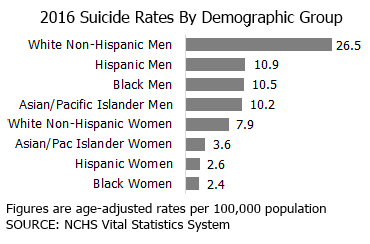
We also live in a society that would come running if I were to break my arm and sign my cast, but if I were to disclose depression or suicidal thoughts, people might judge or run the other way. For many of us, talking about our emotions and feelings may feel uncomfortable or even foreign. Some of us may have been taught to suppress emotions, keep our heads down, work hard, and don’t be a problem. Sound familiar? Strangely and perhaps sadly, this mindset is reminiscent to our society’s version of success. But, as I like to ask my stoic, hard-working clients, how’s that working for you? Furthermore, with suicide rates and depression rates on the rise, how’s that working for us- as a society, community, family?

depression men2

We have all experienced our share of emotional pain and struggle. Many of us have a personal story about suicide whether it is regarding ourselves or somebody else. Suicide can have profound impacts on communities. In the small towns of Silverton and Sisters where I practice, the impact of tragedy can feel more intense, palpable, and immediate. The shroud of grief can be heavy. Most of the time, attempting to sweep such things under the rug only perpetuates a sense of isolation and shame.

The misguided notion that suicide is somehow selfish or the easy way out does us no favors and compounds shame and silence. Most often it is rather the point that in desperation, people are overcome by the long, hard struggle of staying alive- many have fought hard time after time and may ultimately feel defeated. They did not simply give up.

suicide causes

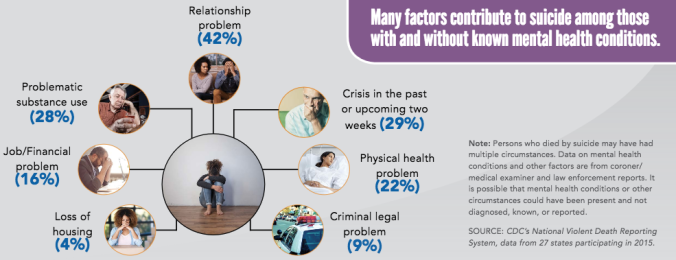
Not everyone who contemplates or completes suicide has a mental illness per se. While mental illness can contribute, rejection, financial woes, impending crises, loss, and/or relationship problems can all be driving factors as well.

suicidesbyregionsuicide demographics

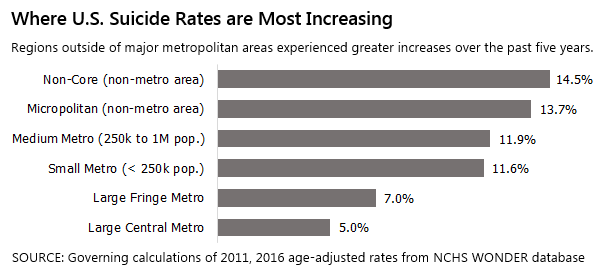
Like many small towns, Sisters and Silverton are charming and somewhat idyllic communities, but certainly both have their emotional layers and undercurrents. People are struggling and too often they are among those you least suspect. We all compartmentalize at times- especially in our go-go-go society, which often gives us little time to grieve, process, and feel, but a community’s social decorum, culture, and pressures can sometimes leave little room for authenticity and acceptance.

Suicide rates are up 30 percent across the nation since 1999. Suicide is the leading cause of death among Oregonians age 10-24. So, we must start asking tough questions, having tough conversations, and allowing space for personal stories to be shared. Talking about suicide and our emotional well-being needs to take place beyond the walls of a counseling office. It is a topic that ought to be talked about in our places of worship, clubs, schools, workplaces, and within the walls of our home. Let’s come together, support one another, strategize, and work towards prevention. We cannot afford to be silent.

depression children


“The power of community to create health is far greater than any physician, clinic, or hospital.”

-Mark Hyman


blog-me2

With gratitude,

Audry Van Houweling, PMHNP-BC, Owner, She Soars Psychiatry, LLC

Sisters & Silverton, Oregon, www.shesoarspsych.com


Binging, Booze, Boys, Bags, & Beachbody… Our attempts to escape the inescapable.

Do you struggle with sitting still? Is watching a movie, reading a book, or even having a conversation a test of your patience? Many of us have become accustomed to a routine of constant stimulation and distraction. Embracing the present can seem counterproductive, like a waste of time, or perhaps even painful. As women we can be pros at creating distractions for ourselves or about reaching an outcome. We give ourselves kudos for being master jugglers. We are praised for our maternalism and caring capabilities, and yet self-care can be met with skepticism.

Afraid of confronting destructive beliefs and patterns, we externalize our problems and blame our bodies, relationships, work environment, and finances among other “causes” rather than looking within. And so, we rely on such things as binging, booze, boys, bags, and never-ending body projects to keep us occupied and detached from our truth. We lose patience as patience is nothing more than simply accepting the present moment.

A note on binging…

blog-binging

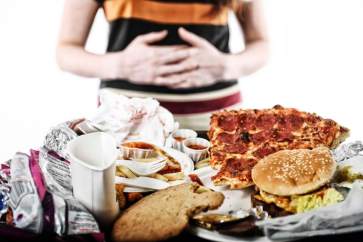
It is often a cycle of guilt, shame, and secrecy. Perhaps when the kids are in bed and the husband is not watching, or a hush-hush trip through the drive-thru, or a secret “snack” drawer at work. Everyone is allowed a sugar-spree every so often, but when binging and food becomes a false sense of control or the mechanism by which we quell our emotions, it can become dangerous and destructive. Rather than feel the discomfort, fear, sadness, or grief, we drown it out with the fleeting pleasure of sugar and salt on our taste buds. We might gain weight, or we might purge to try to cover up the “evidence”. The guilt takes over and then the feelings, which must again be quieted.

A note on booze…

BLOG-BOOZE

While there has been a recent spotlight on opioid and prescription drug use, alcohol use has quietly been climbing and deaths attributed to alcohol continue to rival any other substance. High risk drinking, which was defined in the study as women consuming more than 4 drinks per day or men consuming more than 5 drinks per day increased by 30% between 2001-2002 to 2012-2013. Among women specifically, high risk drinking increased by nearly 60%. In the Northwest, alcohol consumption and being privy to the latest and greatest brew pub is associated with social prowess and prestige.

A note on boys…

blog-boys

Lust, codependency, and compromising our own comfort to satisfy. It is human nature to fantasize and want to please to an extent, but boys or whomever you place affection can be a powerful distraction and our means to validation and self-worth. We might be plagued by self-doubt if we assume we are not meeting expectations. Sometimes we may subconsciously (or consciously) seek out or relive situations reminiscent of past traumas or heartache to try to make the traumatic pleasurable or find power when we previously may have felt powerless.

 A note on bags…

blog-bags

I was in Las Vegas recently and took some strolls through the opulent designer rows filled with top trends to satiate high rollers. It is all a bit exciting for a moment and then I found myself rather quickly disillusioned. I suddenly felt pride for my $15.00 Target purse and my sleek black jumpsuit I got from Ross Dress for Less. Really, who gives a damn and if they do, do I give a damn? I must admit I enjoy shopping, fashion, and I understand the power of a first impression. That said, character is not defined by designer labels and if you think external possessions are going to make you happy, you will be quickly disappointed. When it comes to judging one another based on materialism, quite frankly, my give a damn is busted. I think your’s should be too.

A note on Beachbody’s…

blog-food

Your body is your vessel and if you can walk, talk, move without pain, digest your food, and have a healthy heart, there is so much to be grateful for. Many cannot say the same. We take the power of our body for granted as women and we fight the inevitable process of change. We believe that we must punish our body’s until we reach a socially predetermined goal. Through deprivation and often exhaustion we may lose the 10 pounds, but weblog-beachbody reach it having done so with a mentality of shame and self-degradation. We tell ourselves we will finally be happy when we have a 6-pack, lose 10 pounds, run the race, or get rid of the jiggle. Problem is we are acting out of fear rather than love and when fear is the driver, we almost always crash.


Okay so now what?

Okay so you have some vices, guilty pleasures, or admittedly, self-destructive behaviors. Now what?

  • You must take time to practice being OK with the present, which means learning to acknowledge your feelings and fears. This takes practice and intentionality and it might take professional help. Deep breathing, meditation, keeping a gratitude journal, taking a sensory inventory are all small ways to invite the present. This takes practice and intentionality and it might take professional help.
  • Acknowledge your inner child- it is likely desperate to be heard. Picture a hurt child coming to you for help- would you deprive, degrade, and punish that child? That seems cringeworthy as most of us would seek to help that child with gentle curiosity. “What’s wrong? How can I help? Tell me what hurt you? I am here for you. You are going to be OK.” Perhaps then we should be kinder to the wounded child within ourselves. inner child
  • Question everything. Question your core beliefs. Are they born out of fear of love? What behaviors and patterns are energy restorative versus energy depleting? Are you acting and behaving out of compliance or tradition? Has this caused you to sacrifice your personal truth?
  • Treat self-care as a responsibility. This means you honor yourself- your mind, your body, and your spirit. You honor yourself because the energy that you bring into this world has consequences- positive and negative from interacting with the grocery store clerk to your spouse. Take ownership of your energy.

Remember, the present is all you have. Right now, right here, there is power.

Thanks for listening everyone.

blog-me3


With gratitude,

Audry Van Houweling, Owner, She Soars Psychiatry, LLC

www.shesoarspsych.com

Sisters & Silverton, Oregon